
A note on the numbers: This post reflects the best data available when it was published, with sources linked. Distribution moves fast, so we re-check the numbers in our published posts monthly. When something material changes, we update the post and note it at the bottom — no silent edits, no stale stats left standing. Spot something off? Tell us. We’d rather be corrected than comfortable.
This is the second post in a two-part series on the OTA duopoly. The first post mapped the structural shift from rivalry to ecosystem competition. This one goes deeper into the part that actually costs you money: rate leakage.
Here’s a scene: a guest walks up to the front desk with a printed Agoda confirmation showing a rate $30 below your BAR. Your team has no idea where it came from. The rate isn’t loaded on Agoda anywhere you can find. You pull up the reservation, and it shows the booking was actually sourced from Expedia.
This isn’t a glitch. This is the system working exactly as designed.
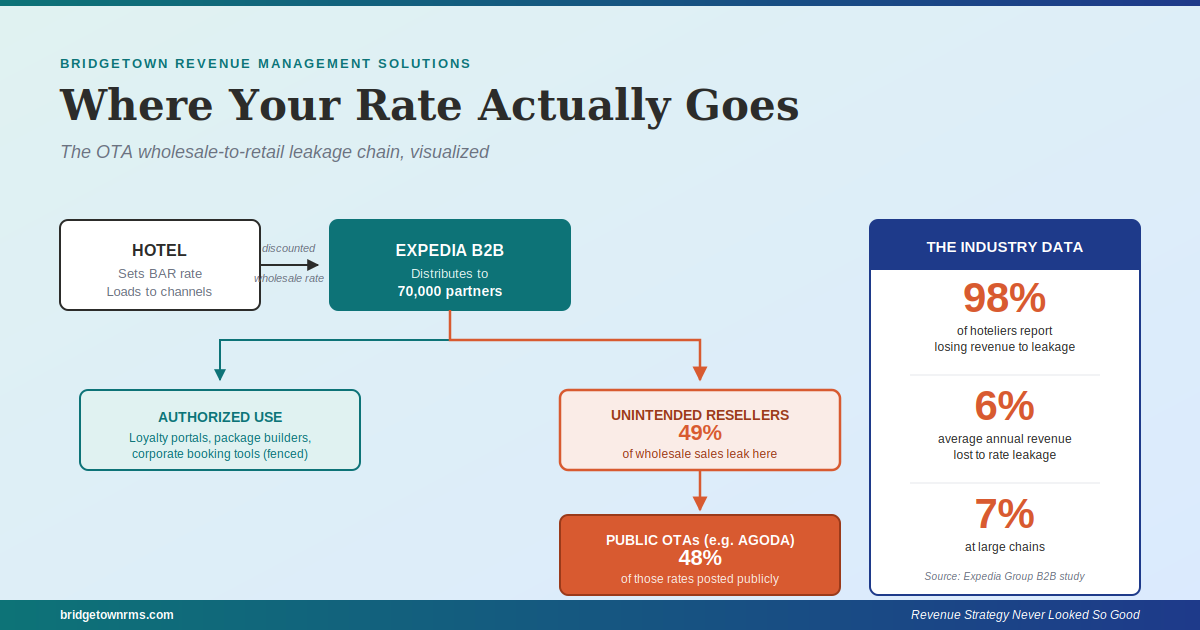
Rate leakage — sometimes called “gray-market distribution” — is now a structural problem, not an occasional bug. Expedia and Booking Holdings are technically competitors, but their B2B supply chains overlap, trade inventory, and route around the public price-parity rules in ways most hoteliers never see. By Expedia Group’s own research, 98% of hoteliers report losing revenue to rate leakage — with an average of 6% of annual revenue lost (7% for large chains), and leakage incidents hitting an average of 8 times per month. Independent rate intelligence firms like Triptease and Lighthouse (formerly OTA Insight) consistently report rate disparities on a majority of properties on any given day, which corroborates the scale.
Here’s how it actually works, why the penalties don’t work, and what hotels are doing in 2026 to fight back.
1. The “Wholesale-to-Retail” Leak
Expedia Group B2B (formerly Expedia Partner Solutions) sells your rooms at wholesale or packaged rates to 70,000 vetted partners worldwide — banks, airlines, retailers, offline travel agents, and corporate travel desks. The intent: those rates flow into private channels (loyalty portals, package builders, corporate booking tools) where they’re fenced off from the open web.
The problem is that some of those 70,000 partners are functionally resellers. They take that discounted Expedia rate and “plug” it into the back end of another OTA — most commonly Agoda, which is itself owned by Booking Holdings.
Per Expedia Group’s own research, 49% of wholesale sales reach unintended partners, and 48% of unauthorized resellers publicly post those rates. The result is the front-desk scene above: a rate lower than your direct site, listed on Agoda, with the merchant of record traceable back to an Expedia affiliate. You’re competing against your own discounted inventory — and the OTA showing the rate isn’t even the one that originally got it.
2. Why Penalties Don’t Work
If you’ve ever caught a leak and reported it, you’ve probably been disappointed by what happens next: the offending partner gets “suspended,” the rate disappears for a week, and then the same thing pops up again under a different reseller name.
This isn’t incompetence. It’s economics.
The whack-a-mole problem. B2B resellers operate under dozens of different business licenses. By the time one is shut down, three more are already live. The compliance team finds the leak; the next one is already running.
Expedia’s conflict of interest. Expedia’s B2B segment is currently the company’s fastest-growing division — up 26% in Q3 2025 — and as of Q2 2026 earnings, the streak has reached 20 consecutive quarters of double-digit growth, with CarTrawler and Tiqets added to the stack this year. The volume from this channel is enormous, and a small percentage of that volume “leaking” out to retail still pencils out as a net positive for Expedia’s bottom line. They’re not financially incentivized to clean it up aggressively. Skift’s reporting on the B2B battleground makes the same point: the OTAs are doubling down on B2B precisely because the margins are good and the volume is sticky.
The Booking Holdings receiving end. Agoda accepts inventory from any high-volume provider it can connect to. If an Expedia B2B partner resells API access into Agoda’s marketplace, the rate appears on Agoda — a Booking Holdings brand. Two parent companies that publicly compete on Wall Street are, in practice, trading inventory through their B2B back ends every day.
3. The 2026 Legal Landscape: Price Parity Is Dying
This is where it gets counterintuitive.
Most hoteliers have heard about the legal pressure on “wide parity” clauses — the contractual rules that prevented you from offering a lower rate on your own website than on the OTA. The EU’s Digital Markets Act designated Booking.com as a “gatekeeper” in May 2024, and Booking can no longer enforce parity for European hoteliers. Several U.S. states have moved in similar directions.
On the surface, this is a win for hotels. In practice, it’s mixed.
The good news: you can legally offer a lower rate on your own website than on Booking.com in the EU. The bad news: now that the OTAs aren’t contractually required to show the same price you do, they feel less obligated to protect your price. Their argument is essentially: “if you can move your price, we can optimize ours — using whatever inventory we can find, including B2B sources.” In other words, the same legal change that frees up your direct strategy gives the OTAs cover to be more aggressive about leaked rates.
Parity used to be a flawed but real backstop. Without it, rate integrity is now a hotel-side responsibility, not an OTA contractual obligation. Kalibri Labs has been making this argument for years in its direct-vs-OTA economics work: the hotels that win the rate-integrity game are the ones that treat distribution as an internal discipline, not a vendor relationship.
4. How Hotels Are Fighting Back in 2026
Since the OTAs won’t police themselves effectively and the contracts no longer help, hotels are moving toward what’s becoming known as technical enforcement. The toolkit is real and works.
“Naked Rate” clauses. Major chains are explicitly banning “unbundled” or “naked” B2B sales in their Expedia contracts. The principle: if your rate isn’t part of a flight + hotel package or another genuine bundle, the partner is in breach. Marriott’s 2019 optimized distribution agreement with Expedia was the template, and Hyatt and Hilton have since pursued similar restructured agreements. It’s not a perfect fix, but it gives you a contractual hook when you find a leak — and it’s no longer just a major-chain play; mid-scale brands and even larger independents are now negotiating versions of the same language.
Source IDs and “watermarked” inventory. Modern Revenue Management Systems and channel managers can “watermark” the inventory you give to Expedia B2B with traceable source IDs. Rate intelligence vendors like Lighthouse, RateGain, and Triptease have built workflows specifically around this: when a leaked rate shows up on Agoda, you can trace it back to the exact API key that distributed it — and demand that specific partner be blacklisted, not just generically “suspended.” This is the single most effective tactic for getting Expedia’s compliance team to actually act.
Fenced loyalty rates. Because AI-driven search tools (ChatGPT, Gemini, Perplexity) and OTA scrapers can’t see “behind the login,” hotels are pushing their best rates into loyalty fences — member-only rates, mobile-app exclusives, geo-fenced offers. If the rate isn’t public, it can’t be undercut. This is the same play Expedia is running with its “Member Only” rates: opacity has become a defensive strategy. SiteMinder’s Changing Traveler Report has tracked the migration of share toward direct and app-based channels as this strategy has spread.
Direct B2B agreements and hybrid distribution networks. Some hotels are stepping around the OTA B2B layer entirely. Industry analysis notes that direct B2B contracting with travel agencies, tour operators, and corporate buyers is having a real revival, particularly in Europe and Asia. Independent consortia like HotelREZ and GuestCentric’s networks, along with newer “micro-GDS” platforms, are letting smaller independents access international agency demand without going through the full bed-bank or mainstream OTA pipe. The economics aren’t always better on a per-booking basis, but the contractual control is.
Audit, audit, audit. And the unsexy one: regular shopping audits. The PhocusWire 2026 fee analysis makes it clear that distribution costs across the board are climbing — OTA commissions, payment processing, channel manager fees, software fees — and rate leakage is one of the few areas where active monitoring directly recovers revenue. Most hotels under-invest in this. The ones that don’t can recover several percentage points of RevPAR by quarter-end.
How leaky is your distribution right now?
Get the next BRMS post in your inbox
Honest takes on revenue management, distribution, and what’s actually working for hotels in 2026 — delivered when we publish, not on a schedule. No spam, no fluff. Unsubscribe anytime.
Sources & Further Reading
- Expedia Group: Inside the Complex Journey of Hotel Rates — Expedia’s own October 2025 research with the 49% / 6% / 98% figures.
- Hospitality Net: The Untold Story of Rate Misuse — press summary of the same research with additional detail on costs ($40,100/year average to manage B2B distribution).
- Expedia Group Q3 2025 Results — 26% B2B growth; the streak reached 20 consecutive quarters as of Q2 2026 earnings (August 2026).
- European Commission: Booking.com Designated as Gatekeeper (DMA) — official designation, May 13, 2024.
- Skift: The B2B Battleground — the structural economics of the OTA B2B shift.
- Marriott + Expedia Optimized Distribution (WiT) — a useful precedent for the “naked rate” contractual approach.
- Odisseymag: Hotel Distribution Networks 2026 — source for direct B2B / micro-GDS strategies and the 70%-of-demand framing.
- PhocusWire: Managing Rising Fees in 2026 — broader context on distribution cost pressures.
More in the OTA Duopoly series: Part 1: Two Different Ecosystems · Part 3: One Page on Who’s Actually Selling Your Rooms (infographic)
Updated August 2026: Refreshed Expedia B2B figures to Q2 2026 (20th consecutive quarter of double-digit growth) and added the incident-frequency stat from the same Expedia Group study. Since this post ran, more than 10,000 European hotels have joined a collective action against Booking.com over rate parity clauses — an Amsterdam court ruling in a parallel case says proving damages will be an uphill fight. We’re watching it.
Leave a Reply